

FC Dallas hosts Orlando City in Mansfield on Wednesday night, in a building that didn’t exist a year ago.
Eric Quill went to the first game there when North Texas SC opened the new venue on July 4. He coached North Texas SC to its first title in 2019, so he has more standing than most to have an opinion about what the place means. And when I asked him for that opinion on Monday, he barely talked about the building itself.
Instead, he talked about the people sitting in it.
Let’s start with the obvious part
The facility is absurd for what it is.
“I don’t know if there’s any second team maybe in the world that’s playing in a facility like this,” Quill said. “Second teams here — you see a lot of them renting from a college, playing on turf, one of their auxiliary fields.”
That’s the honest baseline. The second-team experience across Major League Soccer is a borrowed pitch, a portable goal, and an environment that hasn’t been historically great. Quill described walking into the new Texas Health Mansfield Stadium and taking in the locker rooms, the stands, the whole thing, and reaching a fairly blunt conclusion about his own players.
“I hope our boys know how lucky they are,” he said. “Because this isn’t normal.”
But the building is not his argument. The building is the delivery mechanism for his argument, which is about something else entirely.
North Texas has had homes. It hasn’t had one that fit.
To understand why Mansfield matters, you have to understand what North Texas SC has been playing in over the course of its existence.
The club has bounced around. Some games have been played at Toyota Stadium, sharing the first team’s building. But the bulk of NTSC’s history have been played at Choctaw Stadium in Arlington, a converted baseball park, built for a different spot, sized for a crowd that a second-division soccer team was never going to draw.
The problem wasn’t that nobody came. People came. A few hundred, sometimes more depending on the night.
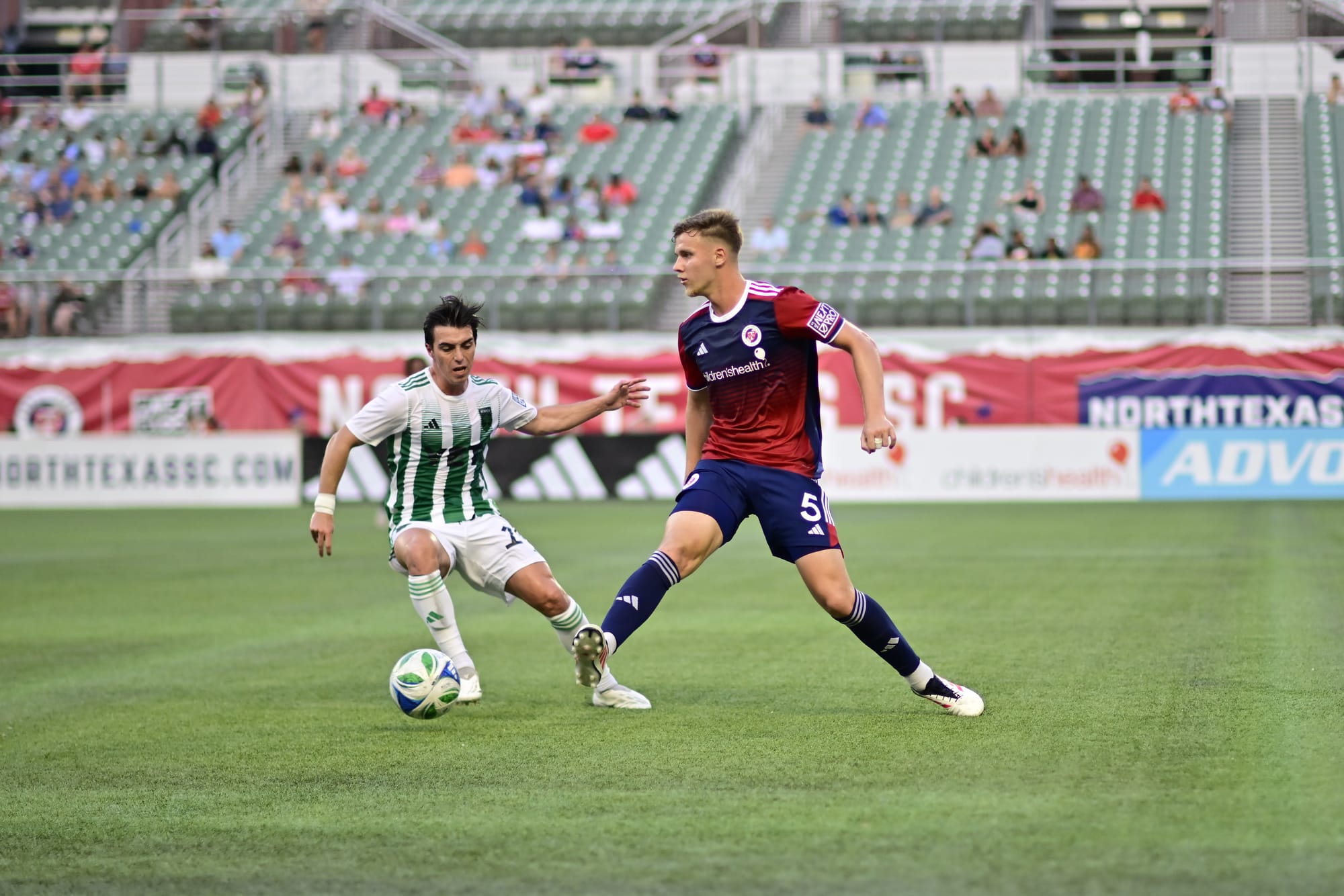
The problem is that a few hundred people in a former Major League Baseball stadium is not an atmosphere. It’s an echo. You can fill Choctaw with a respectable second-teams crowd and still have a build that reads, from the pitch, as empty. The seats stretch back and up into nothing. The sound goes straight out.
Which is precisely the environment Quill spent out conversation arguing against, not because there weren’t fans in Arlington supporting the team, but because the fans there couldn’t make the place feel like anything.
Mansfield is purpose-built and appropriately sized. Fill it and it looks full. That sounds like a cosmetic distinction and Quill would tell you that is the entire point.
“Who are you when the lights are on?”
Quill has a theory of player development, and its not all about the facilities, coaching badges, or training load. It’s about the stress.
His view is that the thing separating a good academy player from an MLS player is what happens to them when it’s uncomfortable and that you cannot manufacture discomfort in front of an empty stadium.
“It’s very easy to have a lot of confidence when nobody’s watching,” he said. “You can try things. Who are you when the lights are on and there’s people in the stands?”
Ricky Louis, welcome to the history books. pic.twitter.com/F17h0FS9co
— North Texas SC (@northtexasSC) July 5, 2026
That’s the whole philosophy in one line for Quill. An empty ground feels like a training match, and a training match doesn’t teach you about how a 19-year old handles a hostile Saturday night. The nerves are the curriculum. If a second-team environment can’t produce nerves, it can’t produce future MLS quality players.
Quill’s evidence for this is his own coaching resume with North Texas SC.
When he managed the club in its early years in USL League One, the team played in front of actual crowds every week. A few hundred here, a few thousand there, but crowds. He also acknowledged what those environments did for future stars who have gone on to represent the US National Team.
Tanner Tessmann. Ricardo Pepi. Both came through those NTSC sides. Both developed, in Quill’s telling, faster than they should have. And he attributes a meaningful chunk of that to the simple fact that they spent their formative professional weekends playing in front of people who cared about the result.
Now Mansfield gives that back.
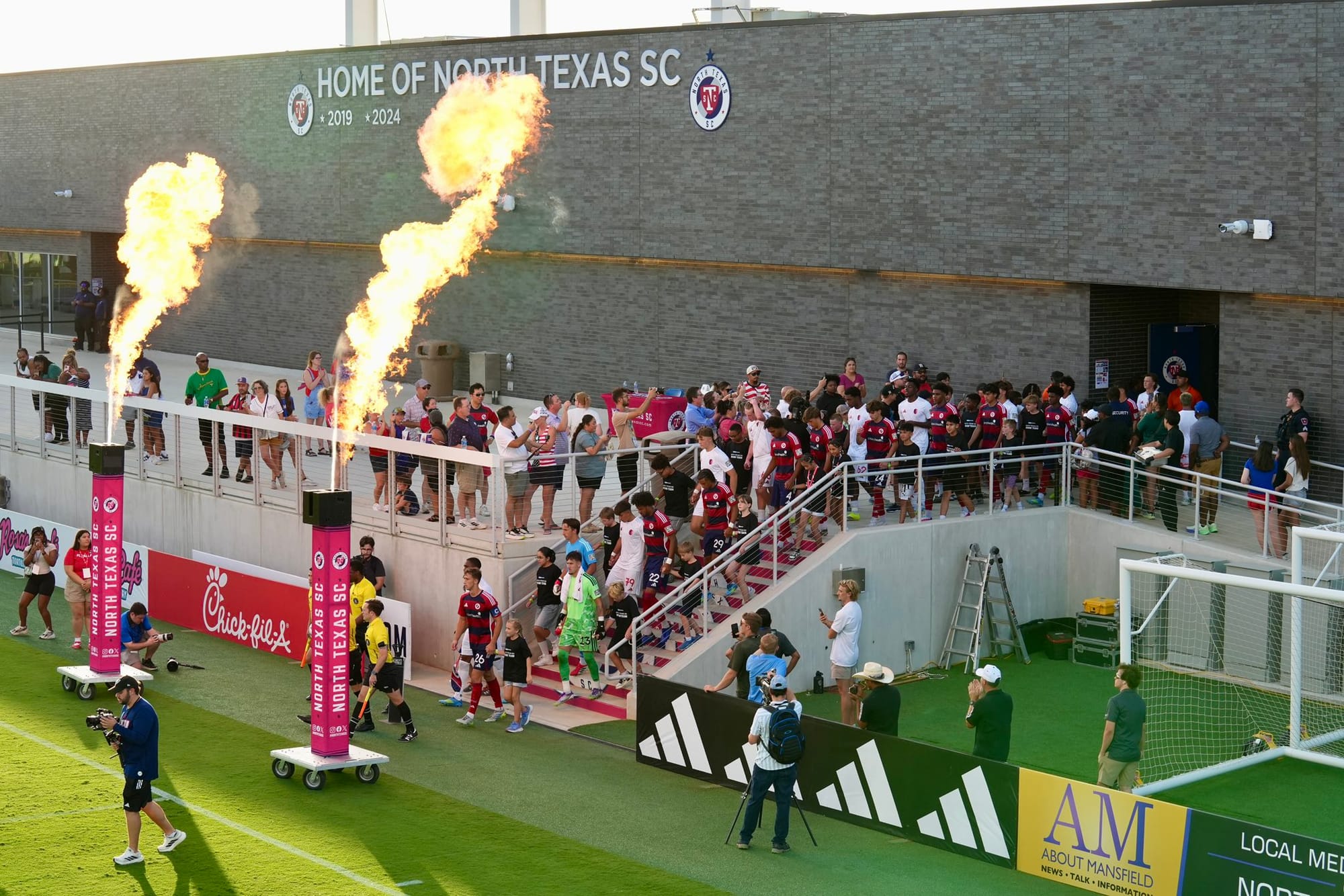
Here’s the part where MLS will probably not be happy…
Here’s where Quill said something a sitting MLS head coach usually doesn’t in an interview.
He isn’t convinced MLS Next Pro is delivering the environment he’s describing. A handful of markets are drawing fans. Most are not coming close. And Quill’s read is that this is a structural problem the league has yet to solve.
“I don’t know how much MLS Next Pro is doing that,” he said. “Some markets are getting some fans, but it’s not — they need to.”
Sit with that line a bit longer. The head coach of an MLS club, talking about the league’s own developmental competition, is telling you the league and its players are being undermined by empty seats. Not underfunded. Not poorly coached or mismanaged. It is down to quiet stadiums.
His solution is the one his club just built, and he’s not modest about it.
“We’re trailblazing, like we always have in the developmental scene,” Quill said. “Our academy has done it the best over time. Now people are catching us. But we’re making a move here with the second team, showing we care deeply. We want our players playing in front of fans.”
Quill credited the Hunt family directly, saying they’ve been willing to make the financial commitment with exactly this vision in mind. In a market where ownership takes its share of incoming, that’s worth writing down.

Free to read. Not free to write.
Big D Soccer is independent FC Dallas coverage — no network, no wire copy, no one telling me what I can't print.
What it actually changes for FC Dallas
Quill’s aside about people catching up is the important one, and it deserves more attention than he gave it.
FC Dallas’ identity, the entire brand of the club, the thing that makes it interesting to outsiders, is largely the academy. That was a genuine competitive advantage for a decade. It is much less of one now. Philadelphia builds players. Salt Lake builds players. Every club in this league is figuring it that Homegrown players are the cheapest good players available in a salary cap system, and the gap Dallas used to enjoy has narrowed considerably.
So the club needs a new edge.
If Quill’s theory is correct, that pressure environments accelerate development, and that almost nobody in MLS Next Pro is providing them, then Mansfield isn’t a nice perk for the second team. It’s an edge nobody else has in MLS Next Pro. Dallas would be the only club in the league systematically exposing its prospects to crowd pressure before they ever reach the first team.
That’s the bet. Whether it pays out will take years to know, and it’ll be measured in players, not attendance figures.
The long view
The most interesting thing Quill said about Mansfield wasn’t about Mansfield at all. It was about what happens if the rest of the league follows this example.
He imagines a version of American soccer where stadiums like this become standard, where second teams draw crowds as a matter of course, and where 15- or 16-year olds are playing meaningful games in real venues.
“I think we may produce more players than we think,” he said.
That’s not a small claim. It’s an argument that the ceiling on American player development isn’t talent identification or coaching, it’s that we’ve been raising professionals in silence.
Wednesday night, Mansfield gets an MLS exhibition game. The building will likely be full, the lights will be on, and the second team’s new home will look, for one night, like the thing Quill thinks it should be every weekend.
Most FC Dallas coverage tells you the second team has a new stadium.
Big D Soccer tells you why the head coach thinks it's the most important
thing the club has built in a decade — and whether he's right.
If you're serious about this club, you should be reading all of it.


